



Speed Does Not Kill…
Impact Does


By La Velle Goodwin
Collision Prevention Specialist
Founder, Driving Hero Academy
Speed Doesn’t Kill. Impact Does.
“Speed kills” is one of the most repeated safety slogans in driving, and it is technically wrong. Drivers know it is wrong because it conflicts with their lived experience. People routinely drive at 110 km/h, 120 km/h, even faster, and arrive in one piece. When safety messaging does not match experienced reality, many drivers stop listening. The truth is more precise and more important to understand. More specifically, serious and fatal crashes occur when speed is combined with insufficient stopping distance (which is almost always the result of inadequate eye lead time). Drivers are travelling faster than the distance they are looking ahead can support. Until we understand that distinction, we will continue teaching the wrong lesson.What Actually Determines Stopping Distance
Most drivers dramatically underestimate how far it takes to stop a vehicle. Stopping is not a single action. It is a sequence of events that begins long before the brake pedal is pressed. There are three distinct stages to stopping a vehicle. • Perception Time Perception time is the time it takes for a driver’s brain to recognize a hazard that requires action. On average, this takes about three quarters of a second. During perception time, the vehicle continues at full speed. • Reaction Time Reaction time is the time it takes for the driver to physically move their foot from the accelerator to the brake pedal. This also averages about three quarters of a second in prepared drivers, meaning the vehicle is still travelling at full speed before braking begins. Together, perception time and reaction time account for approximately 1.5 seconds of travel before braking even begins. • Braking Distance Braking distance is the distance required to bring the vehicle to a complete stop once the brakes are applied. This distance depends on speed, road surface, tire condition, vehicle weight, and braking capability.The Invisible Two-Thirds of Stopping
Most drivers believe stopping begins when they press the brake pedal. In reality, that is the final stage. At 110 km/h (68 mph), a vehicle travels 46 meters (150 ft) during perception and reaction time alone. The brakes have not even engaged yet. This large portion of distance that occurs before braking begins is well established in standard stopping sight distance guidance used in road design and safety analysis. These distances are invisible to most drivers. They are not felt. They are not taught clearly. They are not tested. As a result, drivers assume they can stop within whatever distance they’ll cover once they hit the brakes. That assumption is wrong. This misunderstanding is rarely explained clearly in driver education. In many jurisdictions, understanding perception and reaction distance is not required knowledge for driving instructors, nor is it meaningfully evaluated on road tests.What Is Eye Lead Time in Driving
Eye lead time is the distance ahead of the vehicle that a driver actively scans and processes for hazards. Sufficient eye lead time gives a driver the opportunity to detect hazards, decide what action to take, and begin that action before reaching a hazard. Guidance for defensive driving teaches that drivers should look far enough ahead to allow time to see, think, and act on developing situations. Recommended visual lead distances are about 12 to 15 seconds ahead in normal driving, and 20 to 30 seconds ahead on higher speed roadways (that means that you are looking where your car will be 12 - 15 seconds from now or 20-30 seconds from now) which provides the time and space needed to respond to hazards at speed. Most drivers are not looking far enough ahead for 70 km/h driving, let alone freeway speeds. Many believe the primary goal of driving is simply keeping the vehicle between the lane lines. That does not require looking very far ahead, and it creates a dangerous illusion of control.Driving Too Fast for Conditions
This misunderstanding explains why severe crashes follow predictable patterns at higher speeds. Drivers are not necessarily reckless. They are often travelling at a speed their eye lead time cannot support. When a stopped vehicle, pedestrian, debris, or traffic backup finally enters their field of view, perception time begins. By the time the brain recognizes the hazard and the foot reaches the brake pedal, most or all of the available distance is already lost. At that point, the outcome is largely predetermined.Why Pileups Happen in Fog and on Ice
The same flawed assumption causes every single major pileup in fog and ice. Drivers believe that as long as they keep the car between the lines, they are safe. Consider dense fog on a highway. Visibility may be limited to 10 or 20 meters ahead. A driver may slow from 110 km/h to 80, 70, or even 60 km/h, thinking they are being cautious. Yet at these speeds, the vehicle still travels significant distances during perception and reaction time before braking begins. Combine that with greatly increased braking distances on ice, and available stopping space evaporates. The result is inevitable. One vehicle stops abruptly. Another collides with it. Then another. These are predictable outcomes, not random accidents.The Mathematics of Impact
This is where speed becomes deadly. Kinetic energy increases with the square of velocity. That means every time speed doubles, the force of impact increases fourfold. A crash at 100 km/h does not deliver twice the energy of a crash at 50 km/h. It delivers four times the energy. These forces exceed what the human body can tolerate, making even moderately severe impacts at high speeds far more likely to be fatal.The Fundamental Rule of Safe Driving
• You must always be able to stop within the distance you can see, including perception time, reaction time, and braking distance. • This rule applies at any speed and in all conditions. Day or night. Dry pavement, rain, ice, fog, or snow. • If your eye lead time does not extend far enough to allow you to perceive a hazard, react to it, and stop before reaching it, you are driving too fast for conditions, even if you are under the posted speed limit. • The speed limit tells you the maximum legal speed. Your visibility and eye lead time determine the maximum safe speed. Those two numbers are often not the same.Lower Speed Limits
When speed-related fatalities rise, the default response in some areas is to lower speed limits. It is an understandable instinct. Lower speeds reduce crash severity when collisions happen. That is how physics works. What lower speed limits do not do is change the behaviour of the drivers most likely to make the fatal mistake. Drivers who already believe that driving fast is a demonstration of their above average skills have already decided that speed limits are set for people less skilled than they are. A lower number on the sign does not reach them. It gives them something new to dismiss. Social media amplifies this: self-proclaimed driving experts decry lower limits as arbitrary cash grabs for law enforcement, and the argument lands because it fits perfectly with what most drivers already believe about their own abilities. The limit goes down. The belief that it does not apply to them stays exactly where it was. And the knowledge gap that actually determines whether they can stop in time remains completely untouched. This matters at night, and most of all for new drivers. A teenager who decides to find out how fast the car will go is not necessarily being reckless by their own reasoning. They have one standard: keep it between the lines - it’s what they were trained to do. At high speed on a dark road, the lines are still there. What they do not understand is that their headlights are illuminating a fraction of the distance they now need to stop. Their eye lead time is bounded not just by their attention but by physics. A hazard that appears at the edge of that cone of illumination triggers perception time. Then reaction time. Then braking. At the speeds they are exploring, the math was already unforgiving. In the dark, it becomes un-survivable. This is not just about the underdeveloped prefrontal cortex. It is the entirely predictable outcome of licensing someone without ever requiring them to understand what stopping actually requires. Here is what makes this genuinely fixable: eye lead time is a trainable skill. Teenagers are not incapable of understanding it. When it is taught well, with real explanations of the physics and real practice in traffic at speed, they can apply it. A teenager who understands what their headlights actually cover, and what 1.5 seconds costs them at 140 km/h in the dark, has the information they need to make a genuinely different decision when someone says "let's see how fast it'll go!", assuming their only objective is to stay on track. The problem is not teenagers. The problem is that nobody is making sure they understand this before handing them a licence. With understanding comes adherence. Eye lead time is not tested. It is not consistently required. And most driving instructors do not know it needs to be taught, because their own certification did not require it either. They are not failing their students. They are teaching exactly what their licensing prepared them to teach. The failure is upstream of them, in a system that defines competence as keeping the vehicle between the lines and never asks whether the driver understands the distance required to stop. Lowering the speed limit is an administrative response to a knowledge problem. It addresses the severity of crashes that happen. It does not address the skills nor understanding that would prevent them.Why the "Speed Kills" Slogan Fails
"Speed kills" asks drivers to accept a statement their own experience contradicts. They have driven fast. They have not died. They assume the message doesn't apply to them. The accurate version is more complex but also far more useful: most often, the combination of speed, eye lead time, and available stopping distance determines whether a crash occurs and whether anyone survives it. The speed limit tells you the legal ceiling. Your visibility and conditions tell you the real one. When drivers understand that, the physics starts feeling like information they can actually use. They look further ahead. They adjust speed to match what they can actually see. They create stopping distance not because they were told to but because they understand why it exists. That is the difference between compliance and genuine skill. And it is exactly the gap that "speed kills" has never managed to close. NHTSA data consistently shows that speeding, defined as driving too fast for conditions and not only exceeding the posted limit, is a contributing factor in approximately 29 percent of all traffic fatalities. That figure includes crashes where the driver was at or below the posted speed limit but travelling faster than visibility, road surface, or traffic conditions could support.Frequently Asked Questions
Is "speed kills" actually true, or is it a myth? It is partially true but imprecise enough to fail as safety messaging. Speed by itself does not cause crashes. Impact does, and speed determines how severe that impact is. The more important relationship is between speed and stopping distance. When a driver is travelling faster than their eye lead time and available sightline can support, a crash becomes unavoidable the moment a hazard appears. Drivers dismiss "speed kills" because it conflicts with their experience of driving fast and arriving safely. The accurate version is: driving faster than you can stop is what kills, and most drivers have no reliable sense of where that line actually is. Why can I drive at 110 km/h safely but still crash at the same speed? Because safety at speed depends entirely on what you can see ahead and how far you need to stop. At 110 km/h, your vehicle travels approximately 46 meters before braking even begins, just from perception and reaction time. If a hazard appears within that distance, the outcome is largely determined before your foot reaches the brake. Driving fast on an open highway with long sightlines is a fundamentally different situation from driving fast in fog, at night, or toward a curve. Same speed, entirely different risk. What is eye lead time and why does it matter? Eye lead time is the distance ahead of your vehicle that you are actively scanning and processing. At highway speeds, defensive driving guidance recommends looking 20 to 30 seconds ahead, meaning your eyes should be where your car will be in 20 to 30 seconds, not just ahead of the hood. Most drivers look far too close to the vehicle. When a hazard finally enters their field of view, the 1.5 seconds of perception-reaction time begins, and by the time braking starts, much of the available stopping distance is already consumed. Speed becomes dangerous when it exceeds what your eye lead time can support. How far does a car travel before braking even starts? At 110 km/h, approximately 46 meters. That entire distance is covered during perception and reaction time, the fixed 1.5 seconds every driver needs to recognize a hazard and move their foot to the brake. The vehicle is at full speed the entire time. The Federal Highway Administration uses a 2.5 second perception-reaction window in highway design standards, building in extra margin beyond the average driver's 1.5 seconds because road designers account for worst-case conditions. Most drivers have never been told that margin exists or what it is compensating for. Can you be driving too fast for conditions even under the speed limit? Yes. NHTSA data consistently shows that roughly 29 percent of traffic fatalities involve driving too fast for conditions, and that includes drivers at or below the posted limit. Speed limits are set for typical conditions on a given road. Rain, fog, ice, traffic density, and reduced visibility all change what speed is actually safe. The limit tells you the legal ceiling. Your eye lead time and what you can see ahead determine the real one. Why do multi-vehicle pileups happen in fog even when drivers slow down? Because drivers reduce their speed but not enough to match their actual stopping distance within reduced visibility. In dense fog, visibility may be 15 to 20 meters. Even at 60 km/h, a vehicle covers that distance during perception and reaction time alone before braking begins. When the first vehicle stops abruptly, every driver behind it who cannot stop within their sightline will not stop in time. Every major fog pileup follows this pattern exactly. It is not a freak accident. It is a predictable outcome of speed exceeding visible stopping distance.What does "overdriving your headlights" mean?
It means driving at a speed at which you cannot stop within the distance your headlights illuminate. Standard headlights typically illuminate 40 to 60 meters ahead. At 100 km/h, total stopping distance under good conditions significantly exceeds that. Any hazard that appears at the edge of your headlight range triggers perception time, then reaction time, then braking, in a space that may already be insufficient. Night driving at highway speeds is inherently a situation where most drivers are already overdriving their lights, which is why night crashes are disproportionately fatal.Why does crash severity increase so much with speed?
Because kinetic energy increases with the square of velocity. Doubling your speed does not double the force of impact. It quadruples it. Vehicle structures, airbags, and seat belts are designed to absorb forces within a certain range. Beyond that range, the energy transferred to occupants exceeds what the human body can survive. This is why even modest speed increases at already-high speeds can change a survivable crash into a fatal one.If speed limits don't work, why do we have them?
Speed limits serve two legitimate functions. First, they cap impact severity on roads where crashes are predictable. Lower impact speeds mean more survivable crashes when they happen. Second, they set a legal ceiling below which stopping distance requirements are generally manageable under typical visibility and road conditions. What limits cannot do is close the knowledge gap. A driver who does not understand stopping distance will simply decide the limit does not apply to someone with their level of skill, and a lower number on the sign gives them nothing new to act on. Why isn't stopping distance taught in driver education? In many jurisdictions, understanding perception and reaction distance is not required knowledge for driving instructors, nor is it meaningfully tested on road tests. Instructors teach what their own certification required of them. Most standard licencing programs define competence as vehicle control, keeping the vehicle in the lane and performing manoeuvres correctly. Whether the driver understands the distance required to stop at speed is simply not part of the measurement. The failure is upstream of individual instructors, in a system that never defined that knowledge as required.References
National Highway Traffic Safety Administration. Speeding and Aggressive Driving Prevention. Federal Highway Administration. Speed Concepts: Informational Guide, Chapter 4: Engineering and Technical Concepts. Federal Highway Administration. Stopping Sight Distance. Insurance Institute for Highway Safety. Al-Bdairi, N.S.S., et al. (2024). Unveiling the risks of speeding behavior by investigating the dynamics of driver injury severity through advanced analytics. Scientific Reports.About the Author
La Velle Goodwin is a collision prevention specialist and the founder of Driving Hero Academy. She spent 13 years as a senior instructor at one of North America's most rigorous driver training organizations, completing a certification requiring substantially deeper training in crash causation, driver psychology, and instruction methodology than standard driving instructor licensing, with mandatory annual recertification. She delivered the organization's commercial driver training program, working directly with experienced professional drivers and observing first-hand the psychological resistance that makes behaviour change so difficult to achieve in that population. After leaving, she founded a corporate entertainment company whose programs were built entirely on competitive psychology - using the human drive to compete to move people toward behaviour they would never choose if simply told to. That work ran for over a decade across clients including oil and gas companies, Canada Post, and the Calgary Board of Education. The Crash Proof System brings those two bodies of expertise together: the science of how collisions develop, and the psychology of what actually makes people change.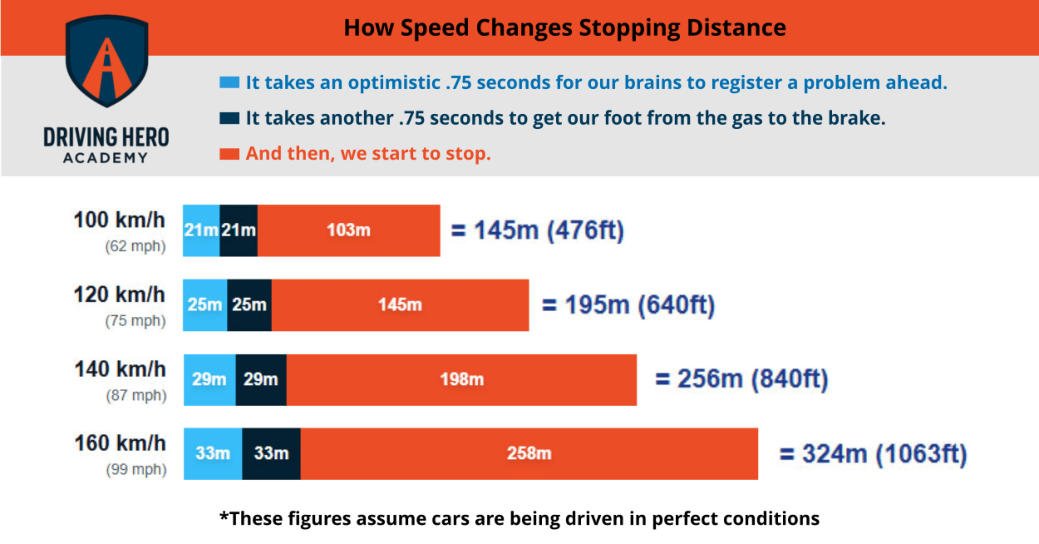

ACADEMY



DRIVING HERO
















Speed Does
Not Kill…
Impact Does

Privacy Policy | Terms

By La Velle Goodwin
Collision Prevention Specialist
Founder, Driving Hero Academy
Speed Doesn’t Kill.
Impact Does.
“Speed kills” is one of the most repeated safety slogans in driving, and it is technically wrong. Drivers know it is wrong because it conflicts with their lived experience. People routinely drive at 110 km/h, 120 km/h, even faster, and arrive in one piece. When safety messaging does not match experienced reality, many drivers stop listening. The truth is more precise and more important to understand. More specifically, serious and fatal crashes occur when speed is combined with insufficient stopping distance (which is almost always the result of inadequate eye lead time). Drivers are travelling faster than the distance they are looking ahead can support. Until we understand that distinction, we will continue teaching the wrong lesson.What Actually
Determines Stopping
Distance
Most drivers dramatically underestimate how far it takes to stop a vehicle. Stopping is not a single action. It is a sequence of events that begins long before the brake pedal is pressed. There are three distinct stages to stopping a vehicle. • Perception Time Perception time is the time it takes for a driver’s brain to recognize a hazard that requires action. On average, this takes about three quarters of a second. During perception time, the vehicle continues at full speed. • Reaction Time Reaction time is the time it takes for the driver to physically move their foot from the accelerator to the brake pedal. This also averages about three quarters of a second in prepared drivers, meaning the vehicle is still travelling at full speed before braking begins. Together, perception time and reaction time account for approximately 1.5 seconds of travel before braking even begins. • Braking Distance Braking distance is the distance required to bring the vehicle to a complete stop once the brakes are applied. This distance depends on speed, road surface, tire condition, vehicle weight, and braking capability.The Invisible Two-
Thirds of Stopping
Most drivers believe stopping begins when they press the brake pedal. In reality, that is the final stage. At 110 km/h (68 mph), a vehicle travels 46 meters (150 ft) during perception and reaction time alone. The brakes have not even engaged yet. This large portion of distance that occurs before braking begins is well established in standard stopping sight distance guidance used in road design and safety analysis. These distances are invisible to most drivers. They are not felt. They are not taught clearly. They are not tested. As a result, drivers assume they can stop within whatever distance they’ll cover once they hit the brakes. That assumption is wrong. This misunderstanding is rarely explained clearly in driver education. In many jurisdictions, understanding perception and reaction distance is not required knowledge for driving instructors, nor is it meaningfully evaluated on road tests.What Is Eye Lead Time
in Driving
Eye lead time is the distance ahead of the vehicle that a driver actively scans and processes for hazards. Sufficient eye lead time gives a driver the opportunity to detect hazards, decide what action to take, and begin that action before reaching a hazard. Guidance for defensive driving teaches that drivers should look far enough ahead to allow time to see, think, and act on developing situations. Recommended visual lead distances are about 12 to 15 seconds ahead in normal driving, and 20 to 30 seconds ahead on higher speed roadways (that means that you are looking where your car will be 12 - 15 seconds from now or 20-30 seconds from now) which provides the time and space needed to respond to hazards at speed. Most drivers are not looking far enough ahead for 70 km/h driving, let alone freeway speeds. Many believe the primary goal of driving is simply keeping the vehicle between the lane lines. That does not require looking very far ahead, and it creates a dangerous illusion of control.Driving Too Fast for
Conditions
This misunderstanding explains why severe crashes follow predictable patterns at higher speeds. Drivers are not necessarily reckless. They are often travelling at a speed their eye lead time cannot support. When a stopped vehicle, pedestrian, debris, or traffic backup finally enters their field of view, perception time begins. By the time the brain recognizes the hazard and the foot reaches the brake pedal, most or all of the available distance is already lost. At that point, the outcome is largely predetermined.Why Pileups Happen in
Fog and on Ice
The same flawed assumption causes every single major pileup in fog and ice. Drivers believe that as long as they keep the car between the lines, they are safe. Consider dense fog on a highway. Visibility may be limited to 10 or 20 meters ahead. A driver may slow from 110 km/h to 80, 70, or even 60 km/h, thinking they are being cautious. Yet at these speeds, the vehicle still travels significant distances during perception and reaction time before braking begins. Combine that with greatly increased braking distances on ice, and available stopping space evaporates. The result is inevitable. One vehicle stops abruptly. Another collides with it. Then another. These are predictable outcomes, not random accidents.The Mathematics of
Impact
This is where speed becomes deadly. Kinetic energy increases with the square of velocity. That means every time speed doubles, the force of impact increases fourfold. A crash at 100 km/h does not deliver twice the energy of a crash at 50 km/h. It delivers four times the energy. These forces exceed what the human body can tolerate, making even moderately severe impacts at high speeds far more likely to be fatal.The Fundamental Rule
of Safe Driving
• You must always be able to stop within the distance you can see, including perception time, reaction time, and braking distance. • This rule applies at any speed and in all conditions. Day or night. Dry pavement, rain, ice, fog, or snow. • If your eye lead time does not extend far enough to allow you to perceive a hazard, react to it, and stop before reaching it, you are driving too fast for conditions, even if you are under the posted speed limit. • The speed limit tells you the maximum legal speed. Your visibility and eye lead time determine the maximum safe speed. Those two numbers are often not the same.Lower Speed Limits
When speed-related fatalities rise, the default response in some areas is to lower speed limits. It is an understandable instinct. Lower speeds reduce crash severity when collisions happen. That is how physics works. What lower speed limits do not do is change the behaviour of the drivers most likely to make the fatal mistake. Drivers who already believe that driving fast is a demonstration of their above average skills have already decided that speed limits are set for people less skilled than they are. A lower number on the sign does not reach them. It gives them something new to dismiss. Social media amplifies this: self- proclaimed driving experts decry lower limits as arbitrary cash grabs for law enforcement, and the argument lands because it fits perfectly with what most drivers already believe about their own abilities. The limit goes down. The belief that it does not apply to them stays exactly where it was. And the knowledge gap that actually determines whether they can stop in time remains completely untouched. This matters at night, and most of all for new drivers. A teenager who decides to find out how fast the car will go is not necessarily being reckless by their own reasoning. They have one standard: keep it between the lines - it’s what they were trained to do. At high speed on a dark road, the lines are still there. What they do not understand is that their headlights are illuminating a fraction of the distance they now need to stop. Their eye lead time is bounded not just by their attention but by physics. A hazard that appears at the edge of that cone of illumination triggers perception time. Then reaction time. Then braking. At the speeds they are exploring, the math was already unforgiving. In the dark, it becomes un-survivable. This is not just about the underdeveloped prefrontal cortex. It is the entirely predictable outcome of licensing someone without ever requiring them to understand what stopping actually requires. Here is what makes this genuinely fixable: eye lead time is a trainable skill. Teenagers are not incapable of understanding it. When it is taught well, with real explanations of the physics and real practice in traffic at speed, they can apply it. A teenager who understands what their headlights actually cover, and what 1.5 seconds costs them at 140 km/h in the dark, has the information they need to make a genuinely different decision when someone says "let's see how fast it'll go!", assuming their only objective is to stay on track. The problem is not teenagers. The problem is that nobody is making sure they understand this before handing them a licence. With understanding comes adherence. Eye lead time is not tested. It is not consistently required. And most driving instructors do not know it needs to be taught, because their own certification did not require it either. They are not failing their students. They are teaching exactly what their licensing prepared them to teach. The failure is upstream of them, in a system that defines competence as keeping the vehicle between the lines and never asks whether the driver understands the distance required to stop. Lowering the speed limit is an administrative response to a knowledge problem. It addresses the severity of crashes that happen. It does not address the skills nor understanding that would prevent them.Why the "Speed Kills"
Slogan Fails
"Speed kills" asks drivers to accept a statement their own experience contradicts. They have driven fast. They have not died. They assume the message doesn't apply to them. The accurate version is more complex but also far more useful: most often, the combination of speed, eye lead time, and available stopping distance determines whether a crash occurs and whether anyone survives it. The speed limit tells you the legal ceiling. Your visibility and conditions tell you the real one. When drivers understand that, the physics starts feeling like information they can actually use. They look further ahead. They adjust speed to match what they can actually see. They create stopping distance not because they were told to but because they understand why it exists. That is the difference between compliance and genuine skill. And it is exactly the gap that "speed kills" has never managed to close. NHTSA data consistently shows that speeding, defined as driving too fast for conditions and not only exceeding the posted limit, is a contributing factor in approximately 29 percent of all traffic fatalities. That figure includes crashes where the driver was at or below the posted speed limit but travelling faster than visibility, road surface, or traffic conditions could support.Frequently Asked
Questions
Is "speed kills" actually true, or is it a myth? It is partially true but imprecise enough to fail as safety messaging. Speed by itself does not cause crashes. Impact does, and speed determines how severe that impact is. The more important relationship is between speed and stopping distance. When a driver is travelling faster than their eye lead time and available sightline can support, a crash becomes unavoidable the moment a hazard appears. Drivers dismiss "speed kills" because it conflicts with their experience of driving fast and arriving safely. The accurate version is: driving faster than you can stop is what kills, and most drivers have no reliable sense of where that line actually is. Why can I drive at 110 km/h safely but still crash at the same speed? Because safety at speed depends entirely on what you can see ahead and how far you need to stop. At 110 km/h, your vehicle travels approximately 46 meters before braking even begins, just from perception and reaction time. If a hazard appears within that distance, the outcome is largely determined before your foot reaches the brake. Driving fast on an open highway with long sightlines is a fundamentally different situation from driving fast in fog, at night, or toward a curve. Same speed, entirely different risk. What is eye lead time and why does it matter? Eye lead time is the distance ahead of your vehicle that you are actively scanning and processing. At highway speeds, defensive driving guidance recommends looking 20 to 30 seconds ahead, meaning your eyes should be where your car will be in 20 to 30 seconds, not just ahead of the hood. Most drivers look far too close to the vehicle. When a hazard finally enters their field of view, the 1.5 seconds of perception-reaction time begins, and by the time braking starts, much of the available stopping distance is already consumed. Speed becomes dangerous when it exceeds what your eye lead time can support. How far does a car travel before braking even starts? At 110 km/h, approximately 46 meters. That entire distance is covered during perception and reaction time, the fixed 1.5 seconds every driver needs to recognize a hazard and move their foot to the brake. The vehicle is at full speed the entire time. The Federal Highway Administration uses a 2.5 second perception-reaction window in highway design standards, building in extra margin beyond the average driver's 1.5 seconds because road designers account for worst-case conditions. Most drivers have never been told that margin exists or what it is compensating for. Can you be driving too fast for conditions even under the speed limit? Yes. NHTSA data consistently shows that roughly 29 percent of traffic fatalities involve driving too fast for conditions, and that includes drivers at or below the posted limit. Speed limits are set for typical conditions on a given road. Rain, fog, ice, traffic density, and reduced visibility all change what speed is actually safe. The limit tells you the legal ceiling. Your eye lead time and what you can see ahead determine the real one. Why do multi-vehicle pileups happen in fog even when drivers slow down? Because drivers reduce their speed but not enough to match their actual stopping distance within reduced visibility. In dense fog, visibility may be 15 to 20 meters. Even at 60 km/h, a vehicle covers that distance during perception and reaction time alone before braking begins. When the first vehicle stops abruptly, every driver behind it who cannot stop within their sightline will not stop in time. Every major fog pileup follows this pattern exactly. It is not a freak accident. It is a predictable outcome of speed exceeding visible stopping distance.What does "overdriving your
headlights" mean?
It means driving at a speed at which you cannot stop within the distance your headlights illuminate. Standard headlights typically illuminate 40 to 60 meters ahead. At 100 km/h, total stopping distance under good conditions significantly exceeds that. Any hazard that appears at the edge of your headlight range triggers perception time, then reaction time, then braking, in a space that may already be insufficient. Night driving at highway speeds is inherently a situation where most drivers are already overdriving their lights, which is why night crashes are disproportionately fatal.Why does crash severity
increase so much with speed?
Because kinetic energy increases with the square of velocity. Doubling your speed does not double the force of impact. It quadruples it. Vehicle structures, airbags, and seat belts are designed to absorb forces within a certain range. Beyond that range, the energy transferred to occupants exceeds what the human body can survive. This is why even modest speed increases at already-high speeds can change a survivable crash into a fatal one.If speed limits don't work,
why do we have them?
Speed limits serve two legitimate functions. First, they cap impact severity on roads where crashes are predictable. Lower impact speeds mean more survivable crashes when they happen. Second, they set a legal ceiling below which stopping distance requirements are generally manageable under typical visibility and road conditions. What limits cannot do is close the knowledge gap. A driver who does not understand stopping distance will simply decide the limit does not apply to someone with their level of skill, and a lower number on the sign gives them nothing new to act on. Why isn't stopping distance taught in driver education? In many jurisdictions, understanding perception and reaction distance is not required knowledge for driving instructors, nor is it meaningfully tested on road tests. Instructors teach what their own certification required of them. Most standard licencing programs define competence as vehicle control, keeping the vehicle in the lane and performing manoeuvres correctly. Whether the driver understands the distance required to stop at speed is simply not part of the measurement. The failure is upstream of individual instructors, in a system that never defined that knowledge as required.References
National Highway Traffic Safety Administration. Speeding and Aggressive Driving Prevention. Federal Highway Administration. Speed Concepts: Informational Guide, Chapter 4: Engineering and Technical Concepts. Federal Highway Administration. Stopping Sight Distance. Insurance Institute for Highway Safety. Al-Bdairi, N.S.S., et al. (2024). Unveiling the risks of speeding behavior by investigating the dynamics of driver injury severity through advanced analytics. Scientific Reports.About the Author
La Velle Goodwin is a collision prevention specialist and the founder of Driving Hero Academy. She spent 13 years as a senior instructor at one of North America's most rigorous driver training organizations, completing a certification requiring substantially deeper training in crash causation, driver psychology, and instruction methodology than standard driving instructor licensing, with mandatory annual recertification. She delivered the organization's commercial driver training program, working directly with experienced professional drivers and observing first-hand the psychological resistance that makes behaviour change so difficult to achieve in that population. After leaving, she founded a corporate entertainment company whose programs were built entirely on competitive psychology - using the human drive to compete to move people toward behaviour they would never choose if simply told to. That work ran for over a decade across clients including oil and gas companies, Canada Post, and the Calgary Board of Education. The Crash Proof System brings those two bodies of expertise together: the science of how collisions develop, and the psychology of what actually makes people change.

ACADEMY



DRIVING HERO




